

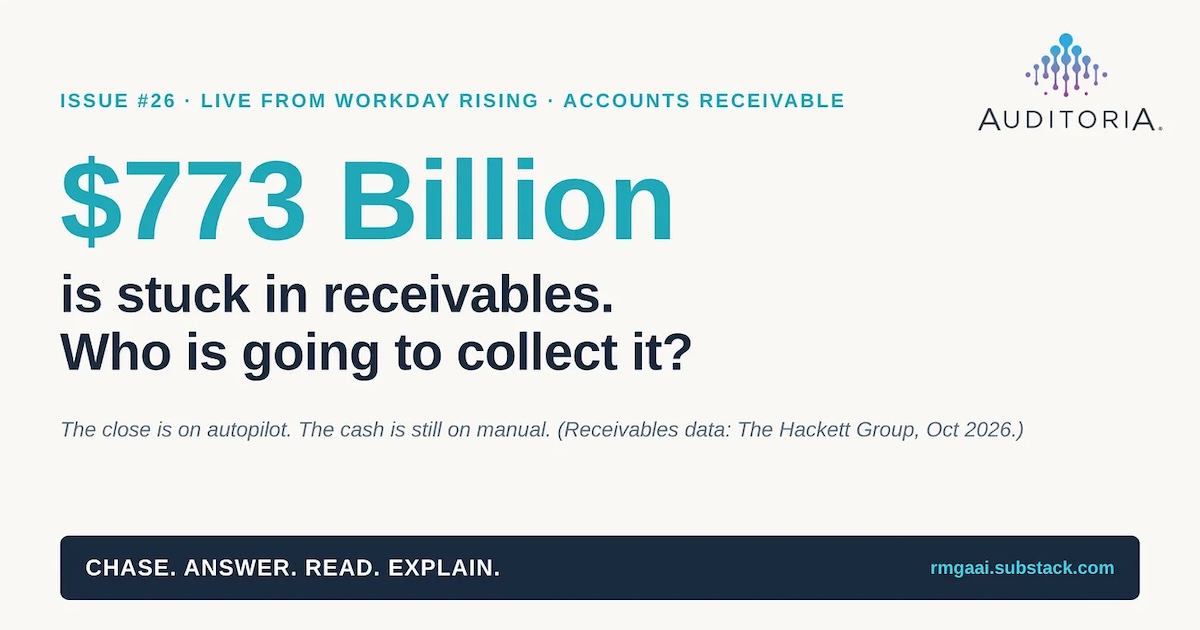
There is a number nobody will put on a keynote slide at Workday Rising in Las Vegas this week, so I will.
Last Monday, The Hackett Group published its annual working capital survey of the largest public companies in North America. The receivables opportunity, the cash tied up in receivables beyond what best performers carry, grew 29% in a year to $773 billion. That is 40% of the entire working capital opportunity. Days sales outstanding got worse by 2.1 days. It was the third straight year of decline, and it happened in 40 of the 50 industries Hackett analyzed.
Read that again. Customers are taking longer to pay, in almost every industry, for three years running. And I have not met a CFO this year who got approval to add collectors to keep up.
Why AR, and why now
For a decade, finance automation money went to payables. That made sense: invoices are documents, and documents were the first thing software learned to read. But payables is where cash leaves. Receivables is where it comes in, and AR is still run largely out of inboxes.
“Can you resend the invoice?” “We paid this last week, here is the remittance.” “Why does our statement show a balance?” “We short-paid because of a pricing issue.” Every one of those emails is a human hour, and every hour a collector spends answering one is an hour not spent on the account that is actually about to go past due. Multiply that across thousands of customers and you get exactly what Hackett measured: DSO drifting up while everyone is busy.
Read the full article on Substack