🏆 Customer Success Story | Online Technology Company
Running AP with AI:
A company that connects people now easily connects invoices to the right entity
The Auditoria Impact
accuracy on invoice data. Up from 5-10% with legacy OCR
reduction in invoice touches. One review in Auditoria, one final review in Workday
team adoption in under one week. Live in production and at capacity within days of go-live
languages supported, out of the box. Japanese and Korean invoices handled without database upgrades or SOWs
Company info
Running a global Accounts Payable operation across four continents, in dozens of languages, with invoices flowing in for multiple brands under a single legal entity is not a simple problem. For this global technology company, it was the everyday reality for a small, centralized AP team managing approximately 2,000 to 2,500 invoices per month across North America, EMEA, and APAC.
For years, that team relied on an enterprise content management (ECM) and OCR platform to process invoices into Workday. The experience was, in the words of the company’s Director of Financial Systems, something she was trying to forget. “It was a compilation of different systems, and they didn’t have a single interface. There was a separate site we had to go to for admin purposes, which was very hard to administer and very hard to learn. The user interface was terrible, and it would go down a decent amount every month.”
Support was no better, and the team commented that questions would go into the void with no person at the other end and no oversight. The core problem was accuracy. When the AP team ran an informal internal survey, the results confirmed what everyone already suspected: OCR capture rates were running at somewhere between 5% and 10%.
“We would need to touch the invoices at least once, twice, or three times in the ECM, and then again as a final review in Workday.”
Processing invoices across languages compounded the challenge further. Handling Japanese and Korean characters required a dedicated database upgrade from the platform. Every change needed a statement of work; nothing was included, and much to the team’s frustration, nothing was simple.
Looking for better technology, not just a new vendor
The search for a replacement was not framed as an AI initiative. The company’s technology philosophy is deliberate: solve specific problems, and let the solution earn its place.
“We were not looking to adopt AI just for the sake of adopting AI. That is not our tech strategy; we always look for solutions to solve specific problems. And if AI can solve those, great.”
What the company needed was a system capable of doing more than reading documents. Processing invoices across a global brand portfolio, where suppliers often invoice against a brand name rather than the legal entity, requires interpretation at every step. Which entity does this invoice belong to? Which cost center? Which approval path? Legacy OCR could not make those decisions as it could only capture what was on the page, and often not even that.
Equally important was Workday integration. The company had consolidated multiple ERPs onto Workday specifically to reduce system sprawl, and any new solution had to sit inside that environment.
The whole point of getting Workday was to centralize the different ERPs we were using across the globe, so our framework is simple: do it in Workday if you can. That’s a big part of why I selected Auditoria. The integration was there.
After first encountering Auditoria at Workday Rising and attending a follow-up session, the team put it through a rigorous evaluation. Given their previous experience with the ECM, their skepticism was justified.
The difference between OCR and an AI agent that actually thinks
What changed with Auditoria was not simply the accuracy rate. It was the nature of the system itself. Where the old system functioned as a document capture tool, applying OCR to extract surface-level data, Auditoria’s agentic AI applies judgment. It reads the invoice, identifies the vendor against a complex entity structure, determines the appropriate coding, flags exceptions, and routes for approval, all without requiring a human to pre-define every possible outcome. As the company’s portfolio grew and its supplier base diversified, that capacity for autonomous decision-making became the critical differentiator.
The accuracy improvement was immediate and significant. Invoice data accuracy moved from approximately 5-10% with legacy OCR to approximately 98% on standard invoice fields. Entity-level matching, the most complex part of the problem, given the company’s multi-brand structure, reached approximately 80% accuracy, a result that had been essentially zero before.
The number of times each invoice was touched dropped from the multiple interactions plus a final review in Workday, down to one review in Auditoria and one in Workday. Reporting, which had previously required manual validation before period close, became immediate.
“With Auditoria, multi-language support was just there at go-live, as it should be with a truly global product, no database upgrades, no SOWs, no extra projects. And the visibility is night and day. It takes me seconds to approve a period close in Auditoria versus digging through everything in the other solution. As soon as you log in, you know exactly where you stand.”
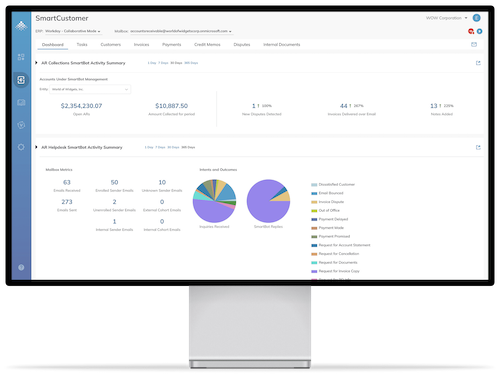
The AP Helpdesk agent handles vendor inquiries autonomously, responding to suppliers without requiring manual intervention from the team. That work is now handled autonomously, freeing the AP team to focus on exceptions rather than correspondence.
Maintaining throughput with fewer resources
The most demanding test of the platform came unexpectedly. When two AP team roles were eliminated across North American and EMEA operations, with no backfill approved, the team absorbed the loss without falling behind on volume.
By combining reduced invoice touches, automated vendor inquiry handling, and streamlined Workday approval thresholds, the team found it had enough bandwidth to maintain volume and timeliness with fewer people. It was an unplanned stress test that, unexpectedly, the new setup passed.
Adoption added to that confidence. With staff already familiar with the Auditoria platform through User Acceptance Testing (UAT) participation, the team reached full operational capacity within the first week of go-live.
Most people said it was easy to learn, and we were at full capacity by the end of the first week. Beyond that, people are just genuinely happier. From an ease of use and operations perspective, everyone I’ve spoken to on the AP team has been really positive about the change to Auditoria.
What comes next
With invoice processing now at steady state, the team’s focus has shifted to adjacent priorities: procurement systems, contract management, T&E automation, and supplier risk monitoring. As the company’s confidence in agentic AI grows, so does its appetite for applying it beyond AP, including, considering AI-assisted finance analytics.
The company’s approach to all of it remains consistent: identify the problem first, evaluate whether the solution actually solves it, and never adopt technology for its own sake.
For others considering a similar move, the advice is straightforward. Major implementations are hard, especially when teams are already running at capacity, but the return on that investment becomes clear once the transition is behind you. And when evaluating a new platform, resist the urge to replicate existing processes within it.
“Don’t try to recreate your current state. Take the time to reevaluate your processes against what the new product can actually do. Had we not been open to changing how we worked and consolidating down to a single email address, I don’t think we would have seen the results we did.”