🏆 Customer Success Story | Momentum Telecom
Gaining momentum with collections automation
The Auditoria Impact
Revenue growth absorbed with just one added collector.
Collector time flipped from manual dunning to critical account management.
Days DSO sustained through 250% revenue growth and a doubling of the customer base.
Automated dunning tailored by acquisition legacy, customer tier, and billing behavior.
Company info
Momentum Telecom has grown by 250% in revenue over the past several years. That growth has come through a combination of organic wins and a sustained acquisition strategy that has expanded the company’s customer base from roughly 3,000 to more than 6,000 today. It has also brought with it an ever-increasing volume of billing relationships to manage, each with different payment behaviors, contract structures, and collection sensitivities.
Through all of it, the collections team has added just one person.
That outcome did not happen by accident. Momentum recognized early that scaling headcount in proportion to revenue growth was not a viable strategy, and that automation was the only path to building a collections function that could grow with the business.
Before Auditoria, the collections team of four to five people was running entirely on manual effort. There were no systems purpose-built for collections. Dunning reports were issued by hand, follow-up calls were uncoordinated, and the team’s time was consumed by administrative work rather than strategic account management. Old receivables sat unresolved because no one had the visibility or the capacity to address them systematically.
“By growing so fast, we have only added very few people to the group, and that’s where Auditoria has really come in to help us,” said Taylor Clark, SVP and Controller at Momentum Telecom. “I needed my people to do more critical thinking and a lot less manual day-to-day work. The team was overworked and didn’t feel like they could do everything that needed to be done. No one was going to approve hiring more collections people, so this was the only way.”
A complicated integration, built for a complex industry
Telecommunications collections are not a standard use case. Momentum operates in a heavily regulated environment, manages customers across multiple legacy billing systems inherited through acquisitions, and runs on a billing platform, Logisense, that few vendors have experience integrating with. Add to that the compliance sensitivities around AI and customer data in specific US states, and the implementation required a level of customization that went well beyond a typical deployment.
Auditoria’s integration with Logisense runs through a universal connector, processes the data, and drives automated dunning communications without ever touching the sensitive invoice data contained in Momentum’s billing documents. Customers who need a copy of their invoice are directed to a self-service portal, keeping the process compliant with applicable regulations.
“Because we are in telecom, there are a lot more restrictions. There are state codes that remain strict on the ability to use AI to access customer data,” Clark noted. “We have a Governance Committee, and we’ve got specific steps we follow.”
Implementation took approximately six months, with the bulk of the timeline driven by the complexity of getting the data mapping and file formatting right between Logisense and the Auditoria platform. Once the integration was stable, the team configured dunning strategies by customer segment, reflecting the different payment behaviors and risk profiles of the various businesses Momentum has acquired over the years.
One of our biggest obstacles was reporting and how we wanted to group the data, because we separate accounts by legacy system. Once we got that nailed down, it was pretty easy.
– Marc Palmese, Manager of Revenue and Collections, Momentum Telecom
What automating AR actually changed
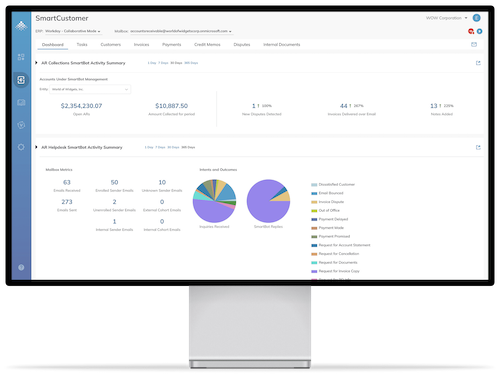
The shift Auditoria delivered was not simply automating emails. Auditoria’s solution works across Momentum’s systems to ingest receivables data, identify the right contacts, apply the correct dunning strategy for each customer segment, trigger communications at the right point in the collections cycle, and surface exceptions that require human attention. The team’s role changed from executing the process to managing and reviewing it.
Before Auditoria, the team estimated that roughly 75% of their time was spent on manual dunning administration. That figure has now effectively flipped to approximately 25%.
That freed capacity has been redirected toward the accounts that require active intervention. Of Momentum’s 6,000+ customers, roughly 300 to 400 at any given time represent genuine collection risk. These are the accounts where negotiation, legal escalation, and proactive account manager involvement make a difference. Previously, the team rarely had time to get to them. Now it is their primary focus.
The reporting visibility has also changed how leadership manages the function. Palmese uses Auditoria’s segmented reporting to assess risk reserves, monitor aging by acquisition base, and maintain an accurate picture of where collections exposure sits across the business at any given time.
“From a reporting perspective, who you’re dealing with matters. It’s important from a write-off and reserve perspective that I know which customers represent more risk, so I can adequately provide for them on the balance sheet,” Palmese said.
Days Sales Outstanding (DSO), which had sat between 30 and 34 days before Auditoria, now averages at around 28 days and has held there through significant customer base growth. In a business where customers are highly incentivized not to fall behind on their telecom bills, the real value is not dramatic DSO improvement. It is maintaining a strong DSO while not adding the headcount that would otherwise be required to do so.
I’m really pleased with Auditoria. It’s made life a whole lot easier, and our collections team is running smoothly. We’ve also been able to double in size and Auditoria has really been our seventh team member.
– Marc Palmese, Manager of Revenue and Collections, Momentum Telecom
What comes next
Momentum is actively working toward a more predictive collections capability. Clark sees the next phase as one in which external credit signals, D&B ratings, and behavioral pattern recognition combine with Auditoria’s existing workflow to provide the team with proactive alerts about accounts showing early signs of risk before they fall behind.
“If a customer has been a consistent payer for four years and is now behind on two invoices, that should be a red flag. Having that kind of trigger, where the system tells you these are the five accounts you need to focus on today and why, would be genuinely useful,” Clark said.
For finance leaders in similarly complex, regulated industries weighing the case for solutions like Auditoria’s in collections, Momentum’s experience makes the argument plainly. The technology does not require a simple environment to deliver value. It requires clear thinking about what the team needs to accomplish, and a willingness to configure it properly for the business you have.